
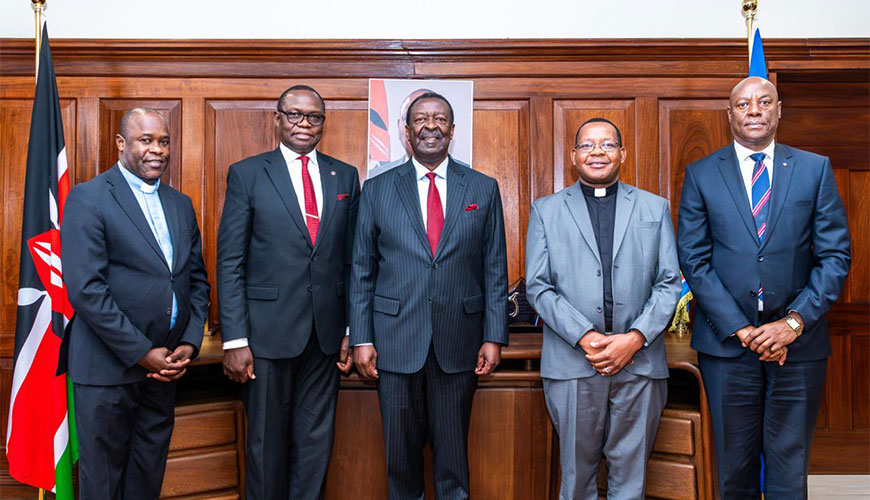
Tangaza University’s top leadership; Vice Chancellor Rev. Prof. Patrick Mwania, CSSp, Chancellor Rev. Fr. Edward Etengu, OSB, and Board of Trustees Chairman Dr. Edward Odundo; paid a courtesy call on to the Office of the Prime Prime held by Prime CS Musalia Mudavadi, marking another step in the University’s growing engagement with national policy on higher education.
The visit brought together government and faith-based education leadership at a moment when Parliament is actively reviewing a set of bills that could reshape how Kenya funds, governs, and delivers education, from teacher training standards to university funding models. As one of the country’s leading Catholic-sponsored universities, Tangaza used the meeting to reaffirm its readiness to be at the table as these reforms take shape, and to share its perspective on what young Kenyans need from their institutions of learning.
Why This Conversation Matters –
Kenya’s universities do not operate in isolation from government policy, and Tangaza has long held the view that meaningful reform is built through dialogue, not delivered from the outside. Discussions of this kind allow the University to bring the lived experience of its lecture halls, laboratories, and communities directly into conversations that will determine how the next generation of Kenyan graduates is trained, credentialed, and prepared to compete globally.
Faith-based universities like Tangaza carry a distinct advantage in these conversations: decades of grounding students not only in technical competence but in ethical leadership and service to community. That combination is central to what Tangaza’s leadership brought into the discussion; a call for reforms that strengthen academic rigor and access, while preserving the values-driven mission that institutions like Tangaza exist to deliver.
Tangaza’s Commitment Going Forward –
The University’s leadership left the meeting with a shared understanding that this engagement is only a starting point. Tangaza has committed to continuing to work alongside the Office of the Prime Cabinet Secretary, the Ministry of Education, and fellow universities to ensure that Kenya’s reformed education system serves students well: equipping them with practical skills, critical thinking, and the character to lead wherever they go.
Train for Kenya’s Future at Tangaza University –
Conversations like this one are a reminder of why the choice of where to study matters. Two Tangaza programmes put students right at the center of the themes shaping this national conversation:
Bachelor of Education (Arts or Science) As Kenya reforms how it trains and supports teachers, Tangaza’s School of Education is preparing the educators who will carry those reforms into the classroom. This four-year, CUE-accredited programme (offered in a flexible blended format, with intakes in January, May, and September) builds pedagogical skill alongside the ability to design, adapt, and scale teaching methods that genuinely work for Kenyan learners. Graduates leave ready to lead classrooms and, in time, help shape the education policies now under discussion in Parliament.
Bachelor of Arts in Communication and Media Studies Every one of the reforms discussed during this visit depends on institutions, government, and communities understanding one another and on young professionals who can help make that happen. Offered through Tangaza’s Institute of Communication, Journalism and Media Studies, this programme sharpens students’ analytical understanding of Kenya’s social, political, and economic landscape while giving them hands-on, multi-platform production skills. It is built for graduates who want to be the ones telling Kenya’s stories and shaping its public conversations, in newsrooms, government communications offices, and beyond.